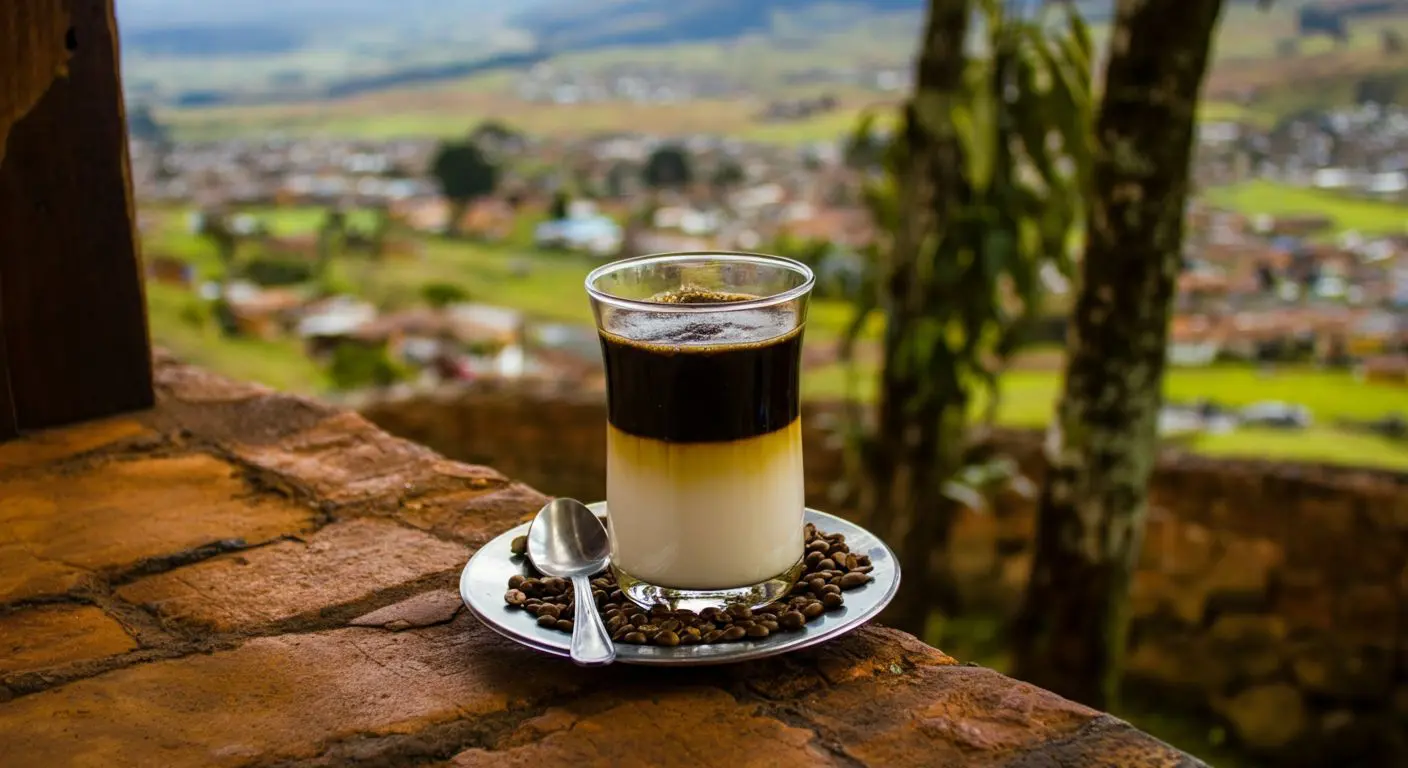

International Coffee Day pays tribute to the most popular beverage on the planet / Photo: Canva Pro
Legend of the Goats and Coffee
When discussing the history of a product with a history spanning millennia, we always encounter numerous legends. It requires time, research, and precision, but I came across one that, according to the sources, I believe best captures the origin of coffee. While the two legends I found present different stories, I also find similarities, such as the fact that the individuals who discovered the bean were religious figures. And then there's the energy that coffee supposedly produced, without anyone knowing the nature of this momentous discovery.Ethiopia and Arabia
We've known about the effects of coffee since the 11th century. In East Africa, there's a legend about a shepherd named Kadil who used to take his goats out to pasture. One night, he found his flock quite agitated, and he didn't understand what was happening. The next day, he chased them to some bushes where the goats were jumping around in a frenzy (I wonder if the famous saying comes from this story). There, he found some slightly fermented red coffee beans in the pasture, which he clearly hadn't been tending to enough. The shepherd, being quite curious, had no choice but to try it to understand what was going on. Indeed, he realized that the coffee was stimulating and made him quite cheerful, even to the point of talking more than usual. And to "end" this legend, they say that the brew reached a monastery, preventing the monks from falling asleep at night. When I say "finish" in quotes, it's because the history of coffee is so beautiful and vast that it's worth exploring, but now we're off on another journey. Travel tip: Discover more about International Coffee Day: Coffee-growing regions of Colombia and what you can do .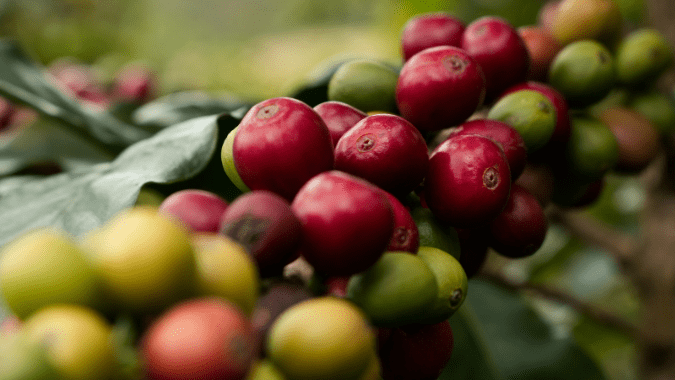
Coffee plants produce different seeds, different beans, and therefore, different coffee. The variety is reflected in its flavor, aroma, and texture. / Photo: Canva Pro
And as another saying goes: “let’s get straight to the point”
You'll likely hear coffee beans referred to as cherries, sometimes because of their bright red color when ripe. And then there's terroir, a French term originally used for wine, coffee, and tea to denote the geographical location where coffee is grown and its significant influence on the final product. I would need to write a lengthy article to fully explain the cultivation and development of coffee; however, I'll focus on one of the final processes: roasting, which many of you have probably heard about. When the bean is roasted, it increases in size and changes color from green to yellow and then to a tan. The different roast levels are defined by color: light, tan, medium, brown, dark brown, French (or semi-black), and Italian (black). When the temperature reaches around 200°C, the beans release oil. This means that the more oil produced, the more flavorful the coffee will be. A roaster can follow certain methods to achieve a desired sensory profile:- The longer the coffee is roasted, the lower the acidity intensity will be.
- The longer the coffee is roasted , the more body a person will feel on their palate .
- If you think the amount of caffeine is involved in the bitterness of coffee, you are wrong, as it actually depends on the roasting process.
- Light roast: The coffee can be quite acidic, medium sweetness, and a low texture.
- Medium roast: It is a balanced coffee and is used to analyze how much potential it has.
- Dark roast: A good roast will show a great body with aromas of chocolate and low acidity.

One of the advantages of whole bean coffee is that it retains its properties better and for longer than ground coffee / Photo: Canva Pro
Varieties: Arabica or Robusta?
Arabica coffee (Coffea arabica) and Robusta coffee (Coffea canephora) are the two most well-known varieties worldwide. The Arabica species originated in Ethiopia. In Colombia, for example, it is the only cultivated species; it grows in tropical climates, on hillsides and mountains, and is a demanding and complex crop to cultivate due to manual harvesting, requiring a significant workforce since it cannot be industrialized. It is the highest quality species worldwide, more aromatic than Robusta, but its plants tend to be more vulnerable. The Robusta species is a larger and more robust tree, as its name suggests. Its plant is stronger, more resistant to pests, and grows at lower altitudes. It differs mainly in flavor; it is not of very high quality and is used in blends. It has a higher caffeine content and is more bitter. Travel tip: Discover the richness of the Coffee Cultural Landscape from a different perspective: aboard an exciting hot air balloon. Don't miss it!
South America is one of the world's main coffee exporting regions / Photo: Canva Pro
A coffee journey through South America
Colombia
I feel very proud to be from the country that boasts some of the best coffee in the world. Not only that, but also from the famous triangle in Colombia known as the Coffee Axis, recognized as a UNESCO World Heritage Site . Colombia is a country of small coffee producers . More than 90% of the farms are very small, producing on less than one hectare, resulting in coffee with completely different flavors. “This is a beautiful rural area that offers visitors a peaceful trip to enjoy nature and some of the best coffee in the world. After all, Colombia is the second largest coffee producer after Brazil ,” says Lucila Runnacles for Daytours4u . But Colombia has many more coffee-producing regions: among them Boyacá, Cauca, Guajira, Cundinamarca, Magdalena, Huila, Nariño, Norte de Santander, Tolima, and Santander. Travel tips: discover a delicious tour with the Coffee Route in Colombia: Tips, excursions, and how to get there . “Currently, brands like Azahar seek to give visibility to these small producers through traceability and by working with them and creating continuous relationships so that they can improve the quality of their product and, on the other hand, guarantee them better payment for that product so that they can continue improving their processes, maintain quality, and at the end of the day have a decent way of life,” says Juan Manuel Ortiz in Mantecast .Ecuador
Coffee arrived late to this small South American country; for this reason, it's not considered a major industrial nation and, economically speaking, it's more dependent on oil. Its production isn't as high as its neighboring countries, and it also imports more coffee than it exports. Flavors: Ecuadorian coffee has medium acidity, a lighter body, and fruity and floral notes. Travel Tips: Discover why you should include Ecuador in your South American itinerary and enjoy this amazing destination.Bolivia
Bolivian coffee grows at high altitudes, similar to Colombian coffee. Coffee is considered gourmet or premium if it receives a score higher than 84 points on a scale of 100, taking into account its aroma, flavor, character, and lack of defects. In Bolivia , coffee produced in Caravani and Cochabamba has achieved a position among the best in the world and is also considered gourmet thanks to the quality of its origin, its floral and fruity characteristics that complement its perfect level of acidity and light body. Of course, this is also due to its exquisite flavor, quality, and the tremendous work of the coffee farmers in its cultivation. Travel tips: Learn more about this wonderful destination with these 5 things you should know before traveling to Bolivia .Peru
Coffee arrived in Peru around 1700, but the industry didn't take off until 1900 when British settlers began cultivating coffee for export to Europe, where it was in constant demand. This led to a significant increase in the coffee industry, and by the late 1920s, the farms were returned to their local inhabitants. The quality of Peruvian coffee is high, with a light body, medium acidity, and sweet, fruity, and floral notes . Travel tip: Enjoy ourBasic Guide to Peruvian Gastronomy .
Enjoying a cup of coffee daily is a tradition in most Latin American countries / Photo: Canva Pro
Brazil
Coffee arrived in Brazil in the mid-18th century, and unlike countries like Ecuador, by 1830 Brazil was already experiencing significant growth in global supply. This was especially true during a time when diseases claimed millions of lives in the coffee industries of Asia and Africa, when Brazil came to produce 80% of the world's coffee. Brazilian coffee ranks first in global production. This is not only due to the country's enormous size but also because its diverse landscapes result in a variety of flavors. One of the most traditional coffee farms , located 96 km from São Paulo, is Campinas, a municipality famous for its coffee, cotton, and sugarcane crops, but particularly for coffee, to which it owes its prosperity. Brazilian coffee has a heavier body compared to coffee from other countries, with low acidity, a smooth taste, and spicy and chocolatey notes. Coffees with fruity and floral notes come from higher altitude areas. Unlike wine or beer, coffee deserves to be honored in our homes, given the respect it deserves for all the hard work that went into its production. Be encouraged to drink more coffee, to prepare it mindfully, to do your research. To recognize and honor the work of the farmer. When I started writing this article, with a blank page, disconnected ideas swirling in my head, and several tabs open on my computer, I thought, "What if I have a coffee?" It was early morning, and my solitary ritual promised a good day.By: Mariana Vélez Zuluaga, a passionate and sensitive Colombian. I write, I eat, and vice versa. Founder, Social Media & Web Content Creator. cometeelcuento .
Published by Has Chacon on 03/06/2026


