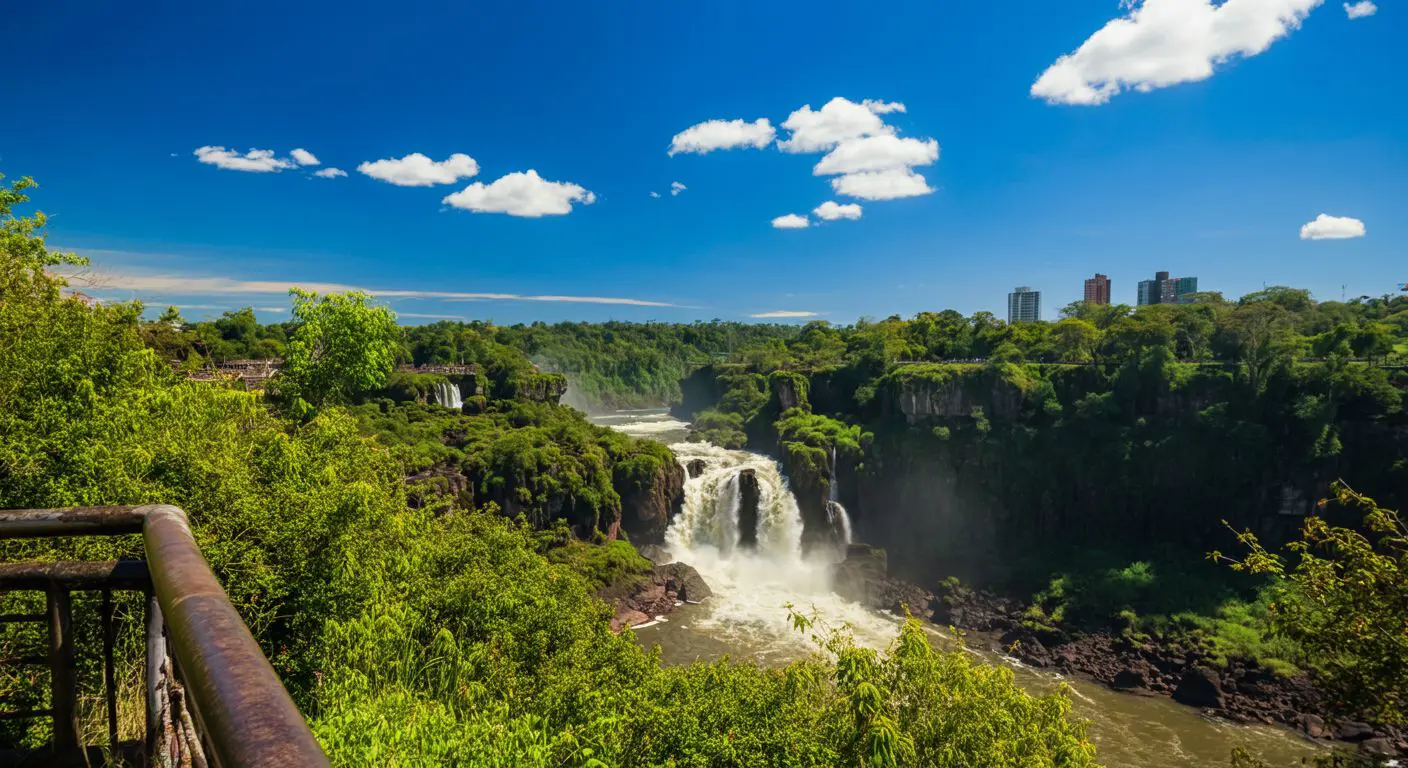
Yes, it is possible to visit Iguazu Falls from Buenos Aires in one day , but it requires very early flights (departure 6:00-7:00 AM), precise coordination of airport-falls transfers, and management of immigration documentation if you wish to cross into Brazil. The effective time at the falls is 4-5 hours.
The 1,300-kilometer distance between Buenos Aires and Puerto Iguazú makes flying the only viable option for a day trip. The direct flight takes approximately 2 hours, but the real challenge lies in coordinating schedules: any delay on the outbound flight can compromise the return, and Iguazu's subtropical climate (with more than 200 rainy days a year) adds a risk variable that doesn't exist in Buenos Aires. Furthermore, the extra costs of traveling independently (transfers, entrance fees, meals, possible flight changes) usually exceed the initial budget.
One-day itinerary in Iguazu Falls from Buenos Aires
This is a typical itinerary for a day trip to Iguazu Falls from Buenos Aires:
5:00 AM – Departure from the hotel in Buenos Aires to Aeroparque Jorge Newbery or Ezeiza (depending on the airline). It is recommended to arrive at the airport 90 minutes in advance for domestic flights.
6:30 AM – Takeoff from Buenos Aires. The earliest flights are usually with Aerolíneas Argentinas, Flybondi, or JetSmart.
8:30 AM – Landing at Iguazu International Airport (IGR). The airport is located 20 kilometers from Iguazu National Park.
9:00 AM – Arrival at Iguazu National Park (Argentine side) after a 20-30 minute transfer.
9:30 AM - 2:30 PM – Tour of the Iguazu Falls. Includes the Lower Circuit, Upper Circuit, and the Devil's Throat. Time is tight, but sufficient to see the main points.
3:00 PM – Departure from the park to the airport.
3:30 PM – Arrival at the airport. It is essential to arrive 60-90 minutes in advance.
17:00 PM – Flight back to Buenos Aires.
7:00 PM – Arrival in Buenos Aires.
8:00 PM – Return to the hotel.
Practical tip: This itinerary works best between April and October, when the days are longer and there is less likelihood of thunderstorms that close the park. In the high season (December-February), flight schedules vary and availability is limited without a 45-60 day advance booking. The airlines currently operating this route are Aerolíneas Argentinas, Flybondi, and JetSmart, with frequencies that change according to the season.
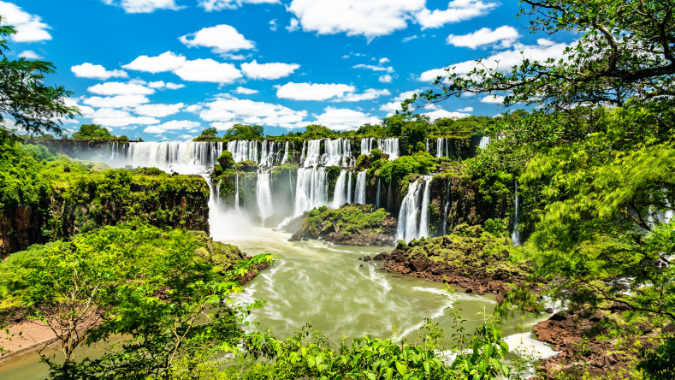 Panoramic view of the Iguazu Falls from the upper walkway — one of the most impressive landscapes on the Argentinian side. source
Argentinian side vs. Brazilian side: which one to visit in one day?
This is one of the most frequently asked questions, and the answer depends on the time available and the documentation you have:
| Aspect | Argentinian side | Brazilian side |
|---|---|---|
| Time required | 4-5 hours | 2-3 hours |
| Type of experience | Immersive, trails, close-up views | Panoramic front view |
| Number of tracks | 3 main circuits + Ecological Train | 1 linear trail of 1.2 km |
| Required documentation | ID card or passport | Passport required (for foreigners) |
| Distance from IGR airport | 20 km (20-30 min) | 15 km + border crossing (45-60 min) |
| Immigration process | Not applicable | Yes, entry/exit stamp. |
| Cost of entry 2026 | AR$ 20,000 (approx. USD 20) | R$ 93 (approx. USD 17) |
| Logistical ease | High | Average (depends on border crossing times) |
Recommendation: If it's your first visit and you only have one day, the Argentinian side offers a more complete experience. 80% of the falls are in Argentinian territory, and the Devil's Throat (the most impressive spot) is best appreciated from this side. The Brazilian side offers spectacular photo opportunities, but crossing the border adds 30-45 minutes which, on a tight itinerary, can create unnecessary stress.
Important consideration: To cross into Brazil, a valid passport is required (an Argentinian ID card is not valid), and minors under 18 traveling without both parents need notarized authorization. This makes the Brazilian side more logistically complex for families.
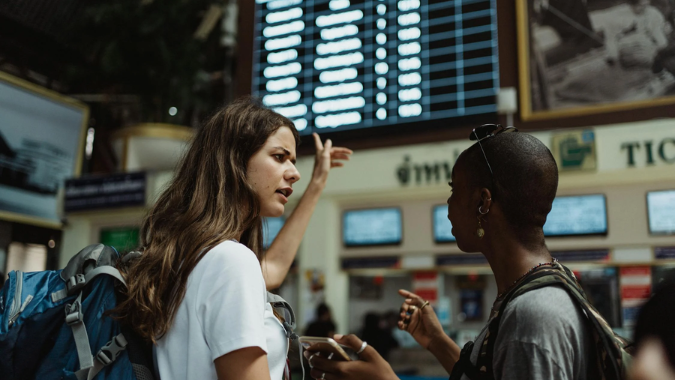 Passengers boarding for Puerto Iguazú — the adventure begins before dawn.
What you need to know before booking.
These are the logistical and practical aspects that are often discovered too late:
The climate is non-negotiable.
Iguaçu has a humid subtropical climate with more than 200 rainy days per year. The average temperature is 25°C, but the perceived temperature due to the humidity can exceed 35°C. This means:
- Clothing: Lightweight, quick-drying items. Avoid jeans or heavy cotton that become soaked and don't dry.
- Footwear: Non-slip sandals or sneakers that can get wet. The trails near the Devil's Throat are constantly fogged.
- Raincoat: A lightweight raincoat is essential. Umbrellas are impractical due to wind and side fog.
Mosquitoes and repellent
The area is endemic for dengue-carrying mosquitoes. Insect repellent with 30% or higher DEET is mandatory. Apply every 3-4 hours, especially in forested areas. Airport and park pharmacies sell repellent, but at prices 50-70% higher than in Buenos Aires.
Fatigue from a long day affects performance.
The complete itinerary takes 16-17 hours from departure from the hotel in Buenos Aires until the return. Of these, 4 hours are for flying, 1-2 hours for transfers, and 4-5 hours for hiking. The combination of early morning hours, heat, humidity, and hiking (the Upper + Lower Circuit + Devil's Throat total approximately 6-7 km) generates fatigue that sometimes overshadows the experience.
Families with children under 7 years old or elderly people should consider this factor.
If the flight is delayed by 1 hour, the plan falls apart.
A 60-minute delay on your outbound flight reduces your time in the park to 3 hours, which is barely enough time to see the Devil's Throat and one of the trails. A longer delay could cause you to miss your return flight, forcing you to buy a new ticket (which on the same day can cost USD 300-400) or stay overnight.
Airlines do not cover these costs if the delay is due to weather (force majeure clause).
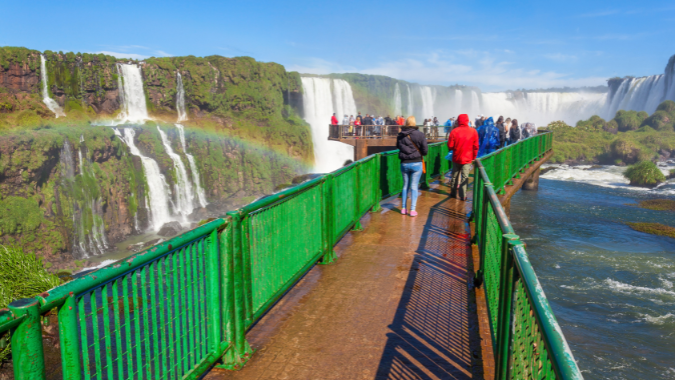 Visitors walking along the upper circuit wearing raincoats — even on sunny days, fog is present. source
Organized tour vs. doing it on your own
This is a true comparison of what each option entails:
| Aspect | Organized tour | On their own |
|---|---|---|
| Flights | Included and coordinated by the agency | Search, booking, and payment are separate. Risk of booking incompatible times. |
| Transfers | Included (airport-park-airport) | Taxi/private taxi management in Iguazu. Coordination of schedules according to flights. |
| Park entrances | Included, no queues | Purchase tickets on-site or online (there may be delays at the ticket office). |
| Guide | Included (bilingual in some cases) | Without explanation. Historical and natural context is lost. |
| Flexible hours | Average (fixed tour times) | High (if everything goes according to plan) |
| Managing unforeseen events | The agency resolves (delays, changes) | The traveler is fully responsible. Stress when faced with problems. |
| Risk of missing the flight | Low (logistics calculated with margin) | High (any delay jeopardizes the return) |
| Approximate total cost | USD 350 - 450 per person | USD 300 - 380 (flight + transfers + entrance fees + meals) |
| Real value | Peace of mind + time optimization | Moderate economy + logistical risk |
Analysis: The price difference between an organized tour and doing it independently is USD 50-70 per person. This difference buys:
- Professional coordination of schedules
- Coverage for unforeseen events (delays, cancellations)
- A guide that explains the history, flora, and fauna.
- Zero logistical stress
For those who value tranquility, the difference justifies the tour. For experienced travelers with time to research and plan, doing it independently is feasible (but not as economical as it seems).
Important tips to make the most of it.
1. Book 30-45 days in advance.
During peak season (December-February and Easter week), flights with compatible schedules sell out 30-40 days in advance. Booking in advance not only guarantees availability but also reduces the cost of the flight by up to 40%.
2. Bring money in Argentine pesos.
Although the park accepts cards, some snack bars, restrooms (which require a fee), and smaller services only accept cash. Bringing AR$15,000-20,000 in small bills avoids inconvenience. The park's ATMs often run out of cash on weekends.
3. Light breakfast before the flight.
The 6:30-7:00 AM flight means waking up at 4:30-5:00 AM. A heavy breakfast can cause discomfort during the flight or hike. Opt for something light (toast, fruit, coffee) and save the substantial lunch for the park.
4. High SPF sunscreen
The UV index in Iguaçu is extreme (10-12) even on cloudy days. Applying SPF 50+ sunscreen every 2 hours is essential. The combination of humidity and mist from the falls can give a false sense of coolness, but the radiation remains intense.
5. Lightweight and waterproof backpack
The goal is to walk comfortably for 5-6 hours. A 10-15 liter backpack containing:
- Water (1.5 liters per person)
- Snacks (bars, fruit)
- Raincoat
- Sunscreen and insect repellent
- Documents in a sealed plastic bag.
Avoid large backpacks or bags that are cumbersome while hiking.
Frequently Asked Questions
How long is the flight from Buenos Aires to Iguazu?
The direct flight between Buenos Aires (Aeroparque Jorge Newbery) and Puerto Iguazú (Iguazú International Airport - IGR) takes between 1 hour 50 minutes and 2 hours 10 minutes, depending on wind conditions. Flights from Ezeiza may take 15-20 minutes longer due to the additional distance from the airport.
Do I need a passport to travel to Iguazu from Buenos Aires?
A passport is not required to visit the Argentinian side of Iguazu Falls. An ID card (or national identity document) is sufficient. However, if you plan to cross into Brazil to see the Brazilian side, a passport is mandatory (an Argentinian ID card is not valid for border crossings). Minors under 18 traveling without both parents need notarized authorization.
What is the best time to visit Iguazu Falls?
The best time to visit is between April and June, and between August and October. During these months:
- There is less rain (although there is always a risk).
- Fewer tourists (except on long weekends)
- More moderate temperatures (18-25°C)
- Balanced flow rate (neither too low nor overflowing)
Avoid December-February (extreme heat, frequent storms, peak tourist season) and July (winter holidays, crowded park).
 A group of coatis near the park entrance—a frequent sight along the trails. Source
Is it worth visiting Iguazu Falls on a day trip from Buenos Aires?
The answer depends on the traveler's profile:
It's worth it if:
- Time in Argentina is limited (5-7 days) and you can't dedicate 2-3 days to Iguazu.
- Are you willing to wake up early and have a long, but intense day?
- You prioritize getting to know one of the most important natural destinations in South America.
- You accept that it will be a panoramic, not a relaxing, tour.
It's not worth it if:
- Are you looking for a peaceful and contemplative experience?
- Are you traveling with very young children or elderly people with reduced mobility?
- The budget is very tight (the cost doesn't justify just 4-5 hours in the park).
- Do you prefer to avoid rigid schedules and potential logistical surprises?
For those who decide to take a day trip, the key is advance planning: booking flights with plenty of leeway, coordinating transfers, checking the weather, and adjusting expectations. It's technically possible, logistically demanding, but an unforgettable experience if done well.
If you prefer to delegate the coordination and focus only on enjoying yourself, check out the organized tour options departing from Buenos Aires that include flights , transfers, entrance fees, and a guide – it can be the difference between a stressful day and a memorable one.
Written by: Carolina Ferere
Published by Hernan Garriga Zimmermann on 03/06/2026


