Are you starting to research your upcoming trip to Buenos Aires ? Or have you just arrived? We offer you a better understanding of how transportation works in Buenos Aires.
The bus:
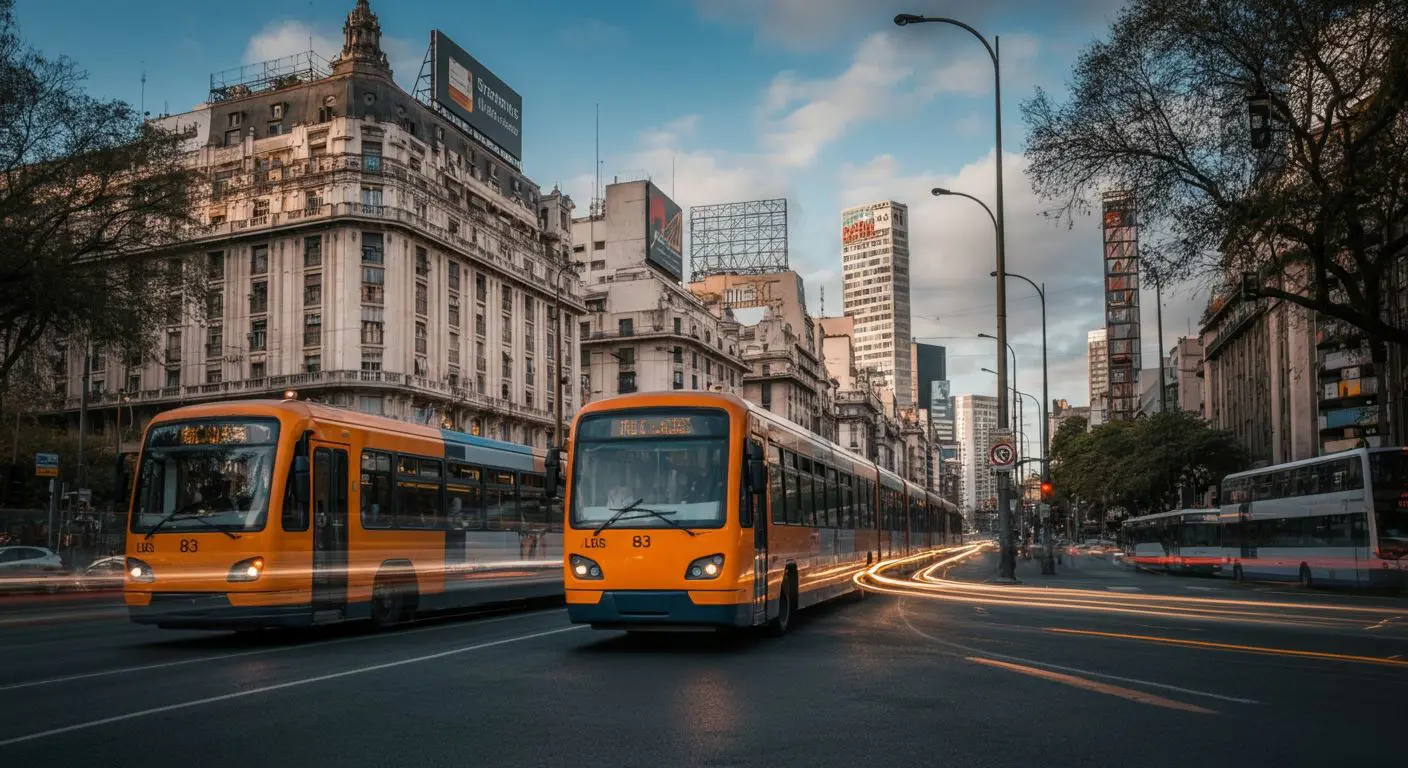
The buses are called "colectivos" and are the most common form of transportation for Porteños (residents of Buenos Aires) , with over 500 buses and a stop every 300 meters on average throughout the city. Here, the buses belong to private companies ; they are all different, not all the same color, nor the same seats, some with air conditioning, others without...
To take a colectivo , you first need to find the stop . This could be a lamppost, a sign, or even a tree; bus stops are less common than in Europe. Then, all you have to do is wait— be careful, you'll be queuing ! Argentinians are very respectful; first come, first served. The queue can stretch for a whole block, depending on the stop. The fare varies depending on your destination . You tell the driver where you're going, and the price will be charged to your sube card . You can also pay with coins, and only coins!
[caption id="attachment_1666" align="aligncenter" width="306"] Map of Sube. / Source [/caption]
August 2014 price list*:
- AR$ 3.25 (€0.29) = To cross the city. - AR$ 3.20 (€0.29) = To go to the next neighborhood. - AR$ 3 (€0.27) = To go a few blocks further.
[caption id="attachment_1665" align="aligncenter" width="374"]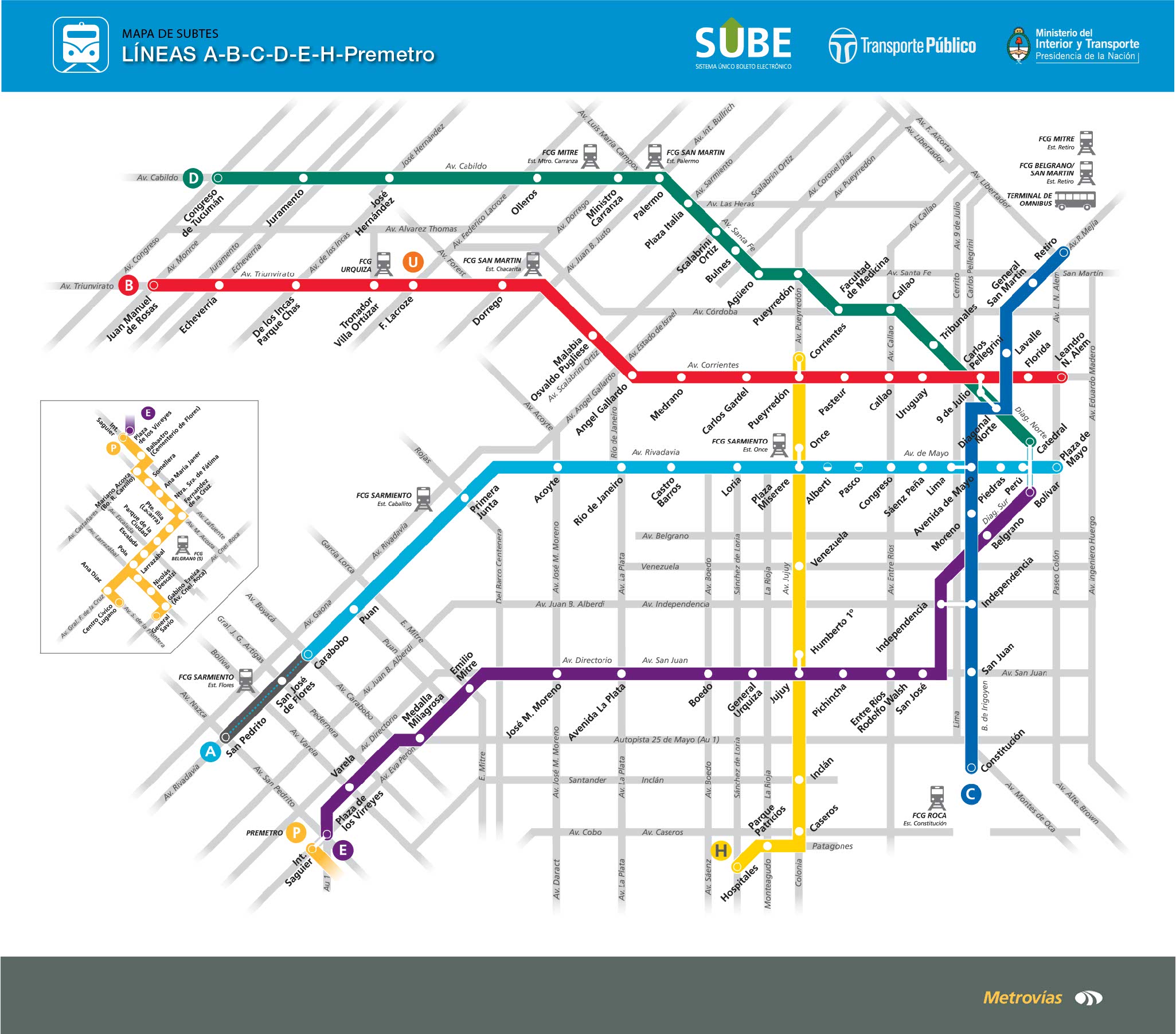 Buenos Aires subway map. / Source [/caption]
The subway:
The metro is most often used to travel from one end of the city to the other without changing trains. Taking the metro is much simpler, with 80 stations , only 6 lines , and just one running vertically through Buenos Aires. As in many capital cities, rush hour is terrible; it's hot, and you're packed in, sometimes very tightly. But here, the Porteños don't lose their friendliness .
The metro uses the same card as the colectivo , a purple Sube card that needs to be topped up at the Boletería, usually located at the metro entrance. You can also pay for a single ride, approximately ARS$4.50 (€0.41)*.The metro hours are from 7:30 am to 10:30 pm , thus encouraging Porteños and tourists to use colectivos .
Keep a close eye on your belongings, wear your backpack in front of you , and be careful with your pockets.
To make your journeys easier, to know more quickly which bus, or other transport to take and where to find it, you can consult the Mapa Interactivo website which is excellent.
The taxi:
It's easily recognizable by its black color and yellow roof . In Buenos Aires, taxis are cheap and safe ; you'll often find a sign on the back of the taxi with the driver's name and which company they work for, especially with Radio Taxi .
[caption id="attachment_1667" align="aligncenter" width="350"]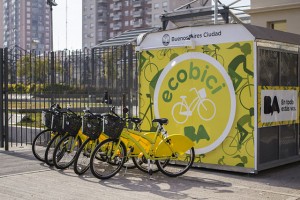 EcoBici. / Source [/caption]
By bicycle:
The Argentinian government has decided to launch a campaign that is simultaneously ecological , cultural , and touristic : EcoBici . With the construction of over 130 kilometers of bike paths, a free service, and easy registration , this campaign is proving popular with workers, young people, and weekend athletes alike.
The government hasn't forgotten tourists ; they too can access this service with a simple registration , a completed form, and the presentation of their original passport and a photocopy. You'll find over 36 bike stations accessible Monday to Friday from 8:00 a.m. to 8:00 p.m. and Saturday from 9:00 a.m. to 3:00 p.m.
To visit Buenos Aires, the best thing is still to walk around ; the city's layout in blocks (cuadras) is very helpful for tourists who are a little forgetful.
Do you want to visit Buenos Aires in an original way? Choose one of our activities or excursions with different themes!
* Prices may increase due to the economic situation in Argentina.
By: Maud Noblet
Published by Has Chacon on 04/06/2026


