1. LANGUAGE
The official language of Uruguay is Spanish (or Castilian) . The accent of Uruguayans is very similar to that of Argentinians ; they share the same Mediterranean influences. Like the Spanish spoken in Buenos Aires, on the other side of the Río de la Plata, the corresponding Uruguayan dialect is called Rioplatense . You will use " vos " instead of " tú " when addressing someone. Another expression you will hear frequently in Uruguay is the interjection "¡ ta !", short for "¡ Ya está !"Another language spoken in Uruguay, albeit informally, is " Portuñol ," a mixture of Spanish and Portuguese. Riverense Portuñol is spoken in the border region of La Paz (the border area encompassing the Brazilian town of Rivera and the Uruguayan town of Santana do Livramento); this language is closer to Portuguese , with some Spanish influences.
2. CLIMATE
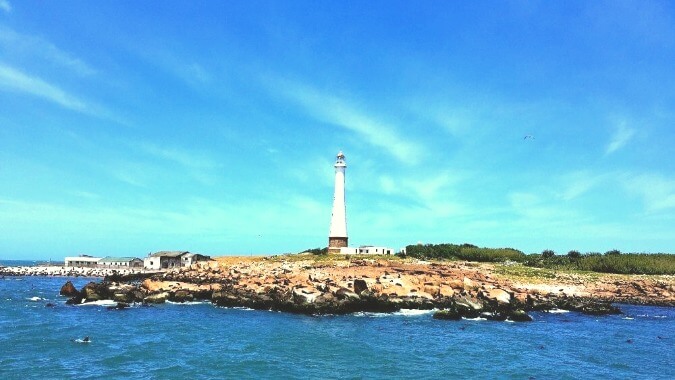
Uruguay's climate consists of distinct seasons, but without drastic variations. It is generally humid subtropical. / Photo: Daytours4u
Uruguay has a humid subtropical climate . Located in the temperate zone of the Southern Hemisphere, the country experiences several seasons, but without significant variations. In summer , temperatures can reach 28°C and drop to 17°C. Summer is characterized by the Zonda , hot winds blowing from the north. In winter , temperatures range between 6°C and 14°C . Cold winds called pamperos originate from the pampas, resulting in a dry and cold climate. Since there are no mountains in Uruguay, the wind can blow fiercely across the entire country , leading to rapidly spreading storms. There is no distinct rainy season: the amount of rainfall is consistent throughout the year and is generally very moderate.3. TIME ZONE
Uruguay is in the UTC/GMT -3 time zone. Daylight Saving Time is observed; it begins on the first Sunday of October and ends in the second week of March. The longest day of the year is 14 hours and 20 minutes, and the shortest is 9 hours and 30 minutes.4. WORKING HOURS
Working hours are generally between 9:00 a.m. and 5:00 p.m. , Monday to Friday, and despite the traditional midday siesta, tourist areas and major shopping centers remain open continuously. This is also the case in Punta del Este and other coastal towns during peak season, where restaurants and chain stores stay open. Shops typically stay open until 6:30 or 7:00 p.m. , while on Saturdays they are only open for half the day.5. RELIGION
Uruguay is a secular country with no official religion and complete religious freedom . The largest religious group is Catholicism, with 47% of the population identifying as such. Over 40% of the population declares no religious affiliation. Secularism in Uruguay is considered one of the reasons for its liberal laws , especially when compared to other Latin American countries. Uruguay was the second country to legalize same-sex marriage and welcomes all travelers. Uruguay is also known for having legalized abortion and the medicinal use of marijuana .6. BANKS AND CURRENCY EXCHANGE OFFICES
To exchange money in Uruguay, simply go to a currency exchange office or a bank. We advise against exchanging money at the airport, as the rates there are very unfavorable. BROU is the national bank. No commission is charged, and there is little difference between the rates at banks and exchange offices. Banks are only open in the afternoon , from 1:00 PM to 6:00 PM. It is possible to withdraw dollars from ATMs throughout the country. The withdrawal limit is $300, but it is possible to withdraw several times in the same day. During the week, there can be long lines at ATMs, especially in Colonia , where many Argentinians travel to Uruguay to withdraw dollars.7. CURRENCY
The country's currency is the Uruguayan peso , its symbol is $ (while the symbol for the US dollar is US$ ). Banknotes are issued in denominations of 50, 100, 500, and 1000 pesos; and coins in denominations of 1, 2, 5, and 10 pesos. It is advisable to always carry small bills and change , as large bills are not accepted in many places.The exchange rate is approximately 1 US dollar to 43 Uruguayan pesos . Check the exact rate here . While it's advisable to exchange currency, you can also pay in many places using US dollars, euros, reais, and Argentine pesos. These different foreign currencies are accepted because many tourists arriving from Buenos Aires spend a day in Uruguay.
8. VISA
The only countries requiring a visa are Russia, Morocco, India, Guyana, Egypt, Armenia, and Albania. There is no entry fee upon arrival in the country. You only need your valid passport . Citizens of neighboring countries , Argentina, Brazil, and Paraguay , only need to present an identity document .9. TAX
Foreigners can claim a VAT refund in Uruguay. To do so, your purchases must have been made with a debit or credit card from a foreign bank. You can request this refund at border crossings at ports, land borders, and airports.10. AIRPORTS
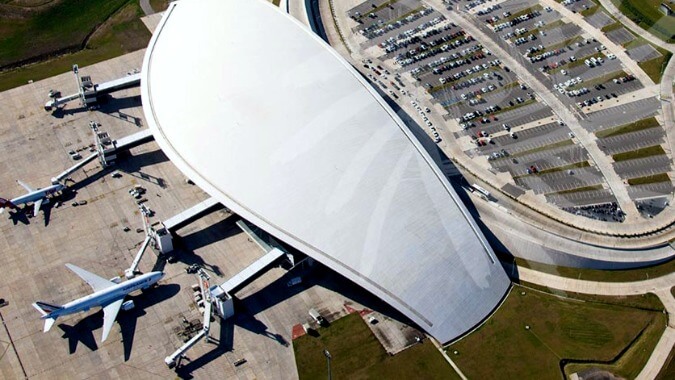
Carrasco International Airport has been chosen as one of the 22 most beautiful airports in the world by the renowned British newspaper HuffPost / Photo: Daytours4u
Carrasco International Airport in Montevideo is the country's main airport . Airlines operating there include American Airlines, Air France, Iberia, LATAM, Aerolíneas Argentinas, and Avianca. A new Uruguayan national airline, Alas Uruguay , will begin operations to replace the former national carrier, PLUNA . It will offer flights from Montevideo to Asunción, Buenos Aires, Santiago, São Paulo, and Rio de Janeiro.11. TRANSPORTATION
Uruguay has a good public transportation network . Taxis and remis (private vehicles) are available throughout the country. Montevideo has a very well-developed bus network . In addition, there are minibuses that provide service between different cities in the country, as well as to Brazil, Paraguay, and Argentina. The main bus station in Montevideo is the Terminal Tres Cruces . Bus routes and fares can be found on Omnilineas . Several regional airports offer domestic flights, but due to Uruguay's small size, it is easier to travel by bus or rent a car. For most nationalities, a driver's license , passport , and a credit card with sufficient funds for the rental are sufficient. Other nationalities require an International Driving Permit . Citizens of the Americas need an IADP (Inter-American Driving Permit). Be aware that gasoline prices in Uruguay are the highest in South America .12. TELECOMMUNICATIONS AND CODE NUMBERS
Public telephones are available in Uruguay. They operate with prepaid cards, which you can easily find at Antel (the national telephone company) stores or newsstands. Cards are available in denominations of 20, 50, 100, 200, or 500 pesos. You can also easily purchase a local SIM card at most newsstands. There are three network providers : Antel, Movistar , and Claro . To call Uruguay, dial +598 followed by the area code and then the phone number. To call Montevideo, dial +598-2 , and to call Punta del Este , +598-42 . Many cafes in major cities offer internet access. Furthermore, most restaurants, cafes, hotels, and public buses have Wi-Fi. Uruguay boasts the best internet service in South America; it's the cheapest and fastest .13. ELECTRICITY
The electricity in Uruguay is 220-240V, 50Hz. Don't forget your universal adapter; the electrical outlets are different from those in France.14. HEALTH
There are no known health risks in Uruguay, and no vaccinations are required for travel. Tap water is safe to drink in cities. Remember to apply sunscreen with a high SPF. Uruguay has a hole in the ozone layer , so the risk of skin cancer is higher. If you spend time outdoors, especially in the summer, be sure to protect yourself by regularly applying sunscreen . Medical services are quite expensive in Uruguay, so we strongly recommend having adequate travel insurance for the duration of your trip that may cover medical emergencies. There are both public and private hospitals. In private hospitals, you will need a valid travel insurance policy or proof of sufficient funds before being treated.In case of a medical emergency, dial 105 to call an ambulance and 911 for emergencies .
15. SECURITY
Uruguay is considered one of the safest countries in South America . Most crime is concentrated in Montevideo, the capital. Montevideo's Ciudad Vieja (Old City) is not a recommended area at night; it's best to avoid it. Be as careful and vigilant as you would in any other major city. Most street crimes are opportunistic (that is, committed because the opportunity presents itself). The rate of violent crime is very low in Uruguay.
16. GASTRONOMY
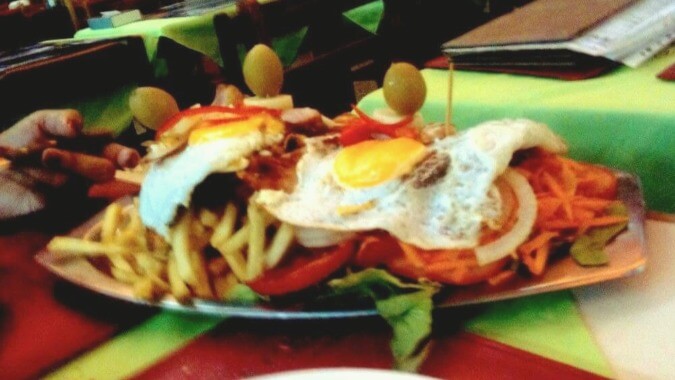
Chivito is one of the few dishes whose origin can be attributed exclusively to Uruguayan cuisine / Photo: Daytours4u
Uruguayan cuisine is heavily influenced by the country's European origins . You'll find a wide variety of pasta, pizza, and sausages . But the star of the show is meat . With an average annual consumption of three cows per person , Uruguayan beef is considered some of the best in the world.It is most commonly eaten as an asado (barbecue). Several types of meat are enjoyed, as well as blood sausage (morcilla) and pan dulce (sweet bread). You can also savor good meat in the form of a Chivito , a type of sandwich with meat, ham, cheese, an egg, and mayonnaise.
For dessert , you'll find many options made with dulce de leche , which is just as popular here as in Argentina. You can also try flan and chassa , a tart made with cream and meringue.
The most popular drink in Uruguay is undoubtedly maté , an infusion made from the leaves of yerba mate , an Amazonian species related to holly. Maté is served in a specific container. Wherever you go in Uruguay, you're bound to see a Uruguayan with a maté in hand, whether in their car, on the street, or at the supermarket.For alcoholic beverages , Uruguay produces excellent wines and is renowned for the Tannat grape variety. Another typical drink is grappamiel , a mixture of grappa and honey. Medio y Medio is a blend of white wine and champagne. You can witness a typical scene in Montevideo where groups of people gather in the bars of the Ciudad Vieja until 5:00 a.m. to drink a glass of whiskey.
17. POPULATION
Uruguayans are very warm and friendly. They usually greet each other with a kiss on the right cheek. As is the case in other Latin American cultures, punctuality is not very important. The dress code is rather conservative.Uruguay is one of the most demographically homogeneous countries in South America. Approximately 90% of Uruguayans are of European descent , primarily from Spain and Italy. The remaining 10% are comprised of Indigenous and Afro-Caribbean minorities, as well as immigrants.
Uruguay places great importance on education . With a literacy rate approaching 98% and a growing middle class, the country is proud to have a much lower level of inequality than the rest of South America.
Tip: We'll take you to discover the most iconic cities, Montevideo and Colonia del Sacramento , don't miss this opportunity and book your experiences in Uruguay with Daytours4u !
By: The Daytours4u internet content team.
Published by Has Chacon on 04/06/2026


